
SDG 13: Climate Action
Reducing our footprint and teaching climate resilience.
SDG 13: Climate Action
Goal 13 is about urgent action on climate change. Through the Erasmus+ SEED project, tree planting along the Mulungushi River, climate degree programmes and a self-funded rooftop solar project, the University builds climate resilience in its community.
2025 in focus
Driving Climate-Responsive Enterprise Development Through International Academic Collaboration
The intersection of education, entrepreneurship and climate resilience presents important opportunities for addressing contemporary development challenges, particularly in communities whose livelihoods depend on climate-sensitive economic activities.
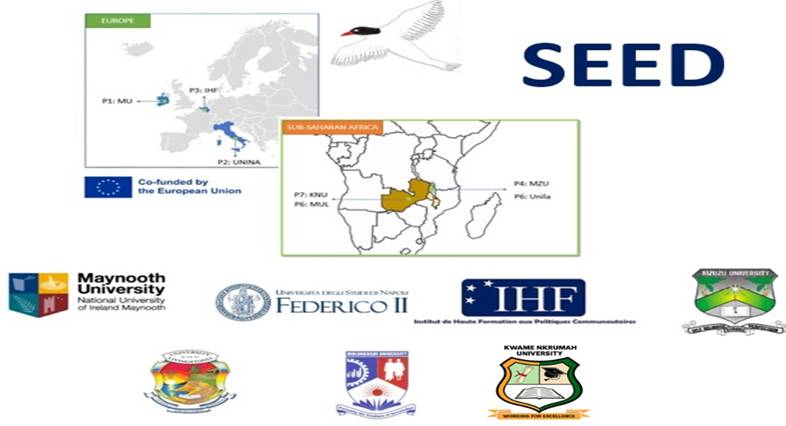
Through its participation in the Sustainable Community-based Enterprise Development (SEED) Project, Mulungushi University is contributing to efforts aimed at strengthening climate-responsive education and sustainable enterprise development.
The three-year Erasmus+ initiative, running from 2025 to 2027, is co-funded by the European Union with a budget of €799,634 and brings together higher education institutions in Zambia and Malawi.
The project seeks to strengthen institutional capacity to develop and deliver micro-credential programmes that respond to community needs while promoting climate-responsive and community-based enterprise development.
During 2025, the University focused on stakeholder engagement, institutional integration and capacity building.
More than 300 stakeholders, including students, staff, community members, government representatives and private sector actors, were engaged through sensitisation activities.
Community needs assessments were also conducted to inform the development of relevant learning programmes, particularly in agriculture and climate resilience.
An important milestone was the completion of a six-week Training of Trainers programme, alongside international capacity-building activities in Ireland. These engagements strengthened academic staff capacity in micro-credential design, quality assurance and community-based learning methodologies.
The initiative reflects a broader institutional commitment to making higher education responsive to environmental challenges and the changing needs of communities.
Through the integration of climate resilience, entrepreneurship and skills development, Mulungushi University is contributing to the development of knowledge and competencies that can support sustainable livelihoods and more resilient communities.
Degree programmes linked to this goal
- Master in Climate Change and Sustainable Development
- Master in Disaster Studies
- Master of Science in Environmental and Natural Resources Management
- BSc in Climatology and Environmental Management
- BSc in Environmental Studies
- BSc in Natural Resources Management
Articles
Building climate resilience with communities through the SEED project and river restoration
Mulungushi University works with local communities to understand climate change and adapt to it. Under the Sustainable Community-based Enterprise Development (SEED) project, a three-year …
ArticlePartnering with the Rotary Club of Kabwe to protect the Mulungushi River
Lower water levels in the Mulungushi River threaten water supply, power generation and farming in Kabwe and the surrounding area. Mulungushi University works with …
ArticleRooftop solar: Mulungushi University's move to clean energy
Recent power cuts (load shedding) forced the University to run diesel generators, which raised costs and emissions. The University's 2024 performance review recommended urgent …